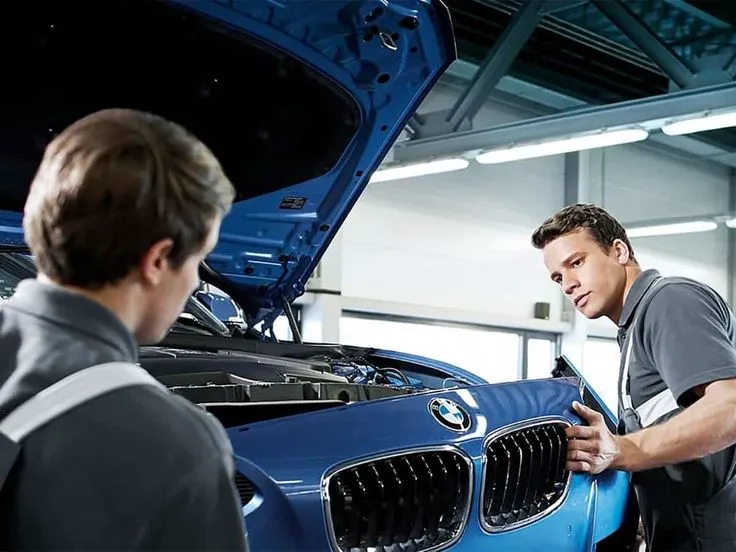
Introduction: Your BMW vs. Delhi — A Battle You Can’t Ignore
Owning a BMW in Delhi is a statement of ambition. It speaks of taste, precision engineering, and a desire for a driving experience that goes beyond the ordinary. But here is the brutal truth most BMW dealers will never tell you upfront: Delhi is arguably one of the harshest environments on the planet for a luxury German automobile.
The city’s summer temperatures regularly breach 45°C, its roads are a patchwork of potholes, speed breakers that could pass for small hills, and construction debris. Add in the relentless stop-and-go traffic of NH48, the Ring Road, and Dwarka Expressway, along with some of the worst air quality indices recorded anywhere in the world — and you have a perfect storm of conditions that accelerate wear, stress the electronics, and degrade even the highest-quality German engineering faster than the manufacturer ever anticipated.
At Automen India, we have serviced hundreds of BMWs across Delhi NCR — everything from the 3 Series and 5 Series to the X5, X7, and the M-badged performance variants. Year after year, the same ten problems surface repeatedly. This guide is our honest, no-fluff breakdown of what goes wrong, why Delhi specifically makes it worse, and what you should do about it before a small issue becomes a ₹2 lakh bill.
1. Oil Leaks: The Silent Engine Killer
What Happens
BMW engines — particularly the N20, N55, B58, and older M54 units — are notorious for oil leaks that develop after 40,000–60,000 km. The three most common failure points are the Valve Cover Gasket, the Oil Filter Housing Gasket, and the Oil Pan Gasket. All three use rubber seals that harden, crack, and lose their compression seal over time.
Why Delhi Makes It Worse
Rubber degrades exponentially faster in heat. When your BMW sits in a Delhi summer sun — or sits in traffic with the engine at operating temperature for 45 minutes on the way home from Connaught Place — the thermal cycling destroys seals far faster than in a temperate European climate. The engine bay temperature in standstill traffic on a 46°C afternoon in Delhi can exceed 100°C.
Warning Signs
- A faint burning smell after parking — oil dripping onto the hot exhaust
- A small dark puddle on your parking spot
- Oil level dropping faster than expected between services
- A misfire or rough idle if oil has leaked onto the spark plug wells (valve cover gasket)
Do not ignore an oil leak. A BMW running 1 litre low on oil will suffer accelerated wear on the timing chain, VANOS unit, and main bearings — all of which are catastrophically expensive to replace. Book a BMW repair service in Delhi at the first sign of leaking oil.
2. Cooling System Failure: Plastic + Delhi Heat = Disaster
What Happens
BMW’s engineers made a cost-saving decision that has frustrated owners worldwide: they built much of the cooling system — expansion tanks, thermostat housings, coolant pipes, and water pump impellers — out of plastic. This plastic is fine in Germany. In Delhi, it is a liability.
Why Delhi Makes It Worse
Constant exposure to extreme heat followed by the rapid cooling that happens when the AC kicks in, or when a monsoon downpour hits your engine bay, causes these plastic components to undergo repeated thermal stress. Over 60,000–80,000 km, micro-cracks form. The expansion tank — which holds your pressurised coolant — is often the first to fail, causing a sudden, dramatic coolant loss that can lead to overheating within minutes.
BMW overheating in Delhi traffic is not just inconvenient. At a sustained 120°C coolant temperature, you are minutes away from a warped cylinder head or a blown head gasket — repairs that can cost ₹1.5–3.5 lakh.
Prevention
Proactively replace plastic cooling system components during your 80,000 km or 6-year service, whichever comes first. A comprehensive cooling system refresh at Automen India’s BMW service centre typically costs a fraction of what a head gasket replacement would set you back.
3. Rapid Brake Wear: Stop-and-Go Traffic Destroys Pads and Rotors
What Happens
BMW’s sport-tuned braking systems are designed for enthusiastic driving on open roads, not for 90-minute commutes in which you brake approximately every 30 seconds. Delhi NCR traffic — specifically the corridors around IGI Airport, Noida Expressway, and Gurugram Cyber City — subjects brake components to far more thermal and mechanical stress per kilometre than the manufacturer’s global average assumes.
We regularly see BMW owners in Delhi needing brake pad replacements at 20,000–25,000 km, compared to the 40,000–50,000 km the pads are rated for under normal use. Rotors show warping signs (steering wheel vibration under braking) even sooner.
What To Do
- Listen for a high-pitched squealing — the brake pad wear indicator is touching the rotor
- Feel for steering wheel vibration or a pulsating pedal under braking — rotor warping
- Do not delay — worn rotors can cause brake fade in an emergency stop
At Automen India, we use OEM-specification or OEM-equivalent brake components to ensure your BMW’s ABS and stability systems interact with the brakes exactly as designed.
4. Suspension Bushing Wear: Delhi’s Potholes Speak for Themselves
What Happens
The BMW suspension is a masterpiece of engineering precision — with one important caveat: it relies on rubber bushings to cushion metal-to-metal contact points throughout the control arms, subframe mounts, and sway bars. These bushings are calibrated to absorb the kind of vibration you experience on a smooth autobahn. They were not calibrated for Mehrauli-Badarpur Road.
Delhi’s roads — particularly in areas like Najafgarh, outer Rohini, and many south Delhi colonies — feature speed breakers that were apparently designed with heavy goods vehicles in mind. When a BMW’s front wheel drops into a pothole or jolts over an unscientific speed breaker, the force transmitted through the suspension can be 3–5 times the impact the car would experience under normal driving.
Warning Signs
- A “thump” or “clunk” sound from the front or rear suspension over rough roads or speed breakers
- Steering wheel vibration at 60–80 km/h (steering wobble from worn front bushings)
- Uneven tyre wear — particularly on the inside or outside edge
- Car pulling to one side even after a wheel alignment
Worn bushings cause misalignment that, if left unchecked, destroys your tyres and puts stress on the wheel bearings and steering rack. A full suspension bushing refresh is well worth the investment.
5. Electrical & Sensor Glitches: The iDrive Dashboard Warning Nightmare
What Happens
BMW’s electronics are arguably the most sophisticated of any mass-market luxury manufacturer. The iDrive system, KOMBI cluster, DSC module, and dozens of ECUs communicate via a CAN bus network that is exquisitely sensitive to voltage fluctuations. When the battery starts ageing or an electronic module begins to fail, the result is a cascade of “phantom” warning lights — DSC, EML, transmission fault, tyre pressure — that appear and disappear seemingly at random.
Why Delhi Makes It Worse
Delhi’s electrical supply can be inconsistent, and the act of starting the engine repeatedly in heavy traffic — particularly in models with start-stop functionality — accelerates battery depletion. Dust infiltration into module connectors is also a significant issue in Delhi’s high-particulate environment.
The Battery Registration Issue
This is critical: BMW batteries must be registered to the vehicle’s ECU using a diagnostic tool when they are replaced. Simply swapping in a new battery at a roadside mechanic without ECU registration will cause charging irregularities and premature failure of the new battery. Always use a certified BMW auto repair specialist in Delhi who has access to ISTA or equivalent BMW diagnostic software for battery replacement.
6. AC Evaporator Leakage: When Delhi’s Pollution Ruins Your Cabin Comfort
What Happens
Delhi’s air quality — with its construction dust, vehicular particulates, and seasonal agricultural burning smog — clogs the cabin air filter and the AC evaporator at an alarming rate. A choked evaporator loses cooling efficiency progressively. In more advanced cases, the dust and moisture combination inside the evaporator creates an acidic environment that corrodes the aluminium fins, causing refrigerant leaks.
Symptoms include a musty smell from the vents (bacterial growth on a dirty evaporator), reduced cooling performance despite the AC running, and in leak cases, a total loss of cabin cooling accompanied by a hissing noise.
Recommended Action
Replace your cabin air filter every 10,000 km in Delhi — not the 20,000–25,000 km the manual suggests (that interval is for European conditions). Have the evaporator cleaned and inspected annually. If refrigerant has been lost, do not simply refill the gas without finding and fixing the leak — it will be gone within weeks.
7. ABS / Wheel Speed Sensor Failure: The Multi-Warning Light Panic
What Happens
Wheel speed sensors are small magnetic sensors positioned next to each wheel hub, designed to measure individual wheel rotation speed and feed data to the ABS, DSC, traction control, and hill-start assist systems. In Delhi, these sensors are exposed to extraordinary amounts of road dust, mud, and moisture — especially during the monsoon season and in waterlogged underpasses.
When a wheel speed sensor fails, it typically triggers a simultaneous illumination of the ABS warning light, the DSC/Stability Control light, and sometimes the brake warning light — which understandably causes considerable anxiety for the driver.
Important Note
When multiple warning lights appear together, do not assume you need multiple expensive repairs. Often, a single faulty wheel speed sensor — a relatively affordable component — is the root cause. Automen India’s BMW diagnostic team uses BMW ISTA diagnostic software to pinpoint the exact fault code and avoid unnecessary parts replacement.
8. Sunroof Drainage Blockage: The Monsoon Leak You Did Not See Coming
What Happens
BMW panoramic and standard sunroofs are designed with drain channels and tubes that run down through the A-pillars and B-pillars to exit water from rain that enters the sunroof frame. In the pollution-heavy environment of Delhi, these drain tubes become clogged with a paste of dust, leaf debris, and solidified particulate matter — often within 2–3 monsoon seasons of purchase.
When the drains block, water has nowhere to go. It overflows into the headliner, soaks into the door pillar foam, and — in severe cases — pools in the floorwells. Water in the floorwells of a BMW is catastrophic for the electronics: the DSC module, seat control modules, and footwell airbag sensors are all located at floor level.
Prevention
- Have your sunroof drains flushed and cleared every year before the monsoon (May/June)
- If you notice a musty smell in the cabin after rain, do not ignore it — check for water intrusion immediately
- Water damage to BMW electronics can result in repair bills exceeding ₹3–5 lakh in complex cases
9. Battery Discharge: The Consequence of Complex Electronics
What Happens
Modern BMW models — especially those with the EfficientDynamics battery management system — have a complex “quiescent current” (the power draw when the car is parked) that can discharge the battery if the vehicle is not driven for extended periods. Unlike older cars where leaving them parked for a week was harmless, a BMW left for 5–7 days without driving can experience a battery discharge that puts it into a deep discharge state, from which the battery rarely fully recovers.
Delhi-Specific Factors
Many Delhi BMW owners have a second car or use chauffeur-driven vehicles for weekday commuting, leaving the BMW parked for days at a time. Additionally, during Delhi’s extreme winter fog (November–January), many owners avoid the car entirely. This is when deep discharge is most likely to occur.
Solutions
- Drive the BMW for at least 20–25 minutes at a speed above 60 km/h at least twice a week to allow the alternator to fully recharge the battery
- Invest in a BMW-compatible smart battery conditioner/trickle charger (CTEK or similar) if the car will be parked for more than 5 days
- When replacing the battery, always use a BMW AGM battery of the correct capacity — and always register it to the ECU
10. Low Ground Clearance Damage: The Underbody Toll of Delhi Roads
What Happens
BMW’s sporting stance and aerodynamic underbody cladding result in a ground clearance of 130–150 mm on most sedans and coupes — compared to 200+ mm on a typical Indian-market SUV. This is completely fine on European roads. In Delhi, it means that virtually every speed breaker in a residential colony, every unmarked hump in a DDA flat parking lot, and every pothole-into-speed-breaker combination on the outer Ring Road poses a genuine risk of contact with the underside of the car.
Common casualty components include the plastic underbody aero panels (which crack and detach), the front bumper lip (which can be scraped off entirely), the exhaust heat shields (which rattle once bent), and in more severe cases, the catalytic converter, which sits low in the exhaust system on some BMW models.
Practical Advice
- Approach speed breakers and steep driveways at a significant angle, not straight on, to maximise effective clearance
- Inspect the underbody at every service for cracked, bent, or missing under-trays — even a missing undertray significantly affects aerodynamic cooling of the engine
- Consider OEM-height suspension for daily-driven BMWs in Delhi rather than lowering springs, which exacerbate the clearance problem
Why Delhi BMW Owners Trust Automen India for BMW Engine Repair and Service
Reading through this list, you might wonder: is there a single workshop in Delhi that truly understands the intersection of BMW’s complex engineering and Delhi’s unique driving environment? The answer is yes — and that is what Automen India was built for.
We are not a general multi-brand garage. Our team is specifically trained in BMW diagnostics, engine repair, and preventive maintenance protocols. We use BMW ISTA diagnostic software, OEM and OEM-equivalent parts, and calibrated workshop equipment to deliver a level of BMW-specific expertise that comes close to the authorised dealer experience — at a significantly more transparent and competitive price point.
What Sets Our BMW Service Apart
- BMW ISTA / ISTA-D diagnostic software for accurate fault code reading and module coding
- Trained technicians with hands-on experience across the full BMW range — 1 Series to 7 Series, X Series, M cars, and PHEV models
- Genuine OEM and OEM-equivalent parts with full traceability
- Transparent, itemised job cards before any work begins — no surprise bills
- Post-service road test and quality check before car delivery
- Specialisation in BMW engine repair in Delhi — oil leaks, VANOS, timing chain, and head gasket work
Whether your BMW needs a routine service, an oil leak fix, a cooling system overhaul, or a full BMW engine repair in Delhi, Automen India delivers the expertise your car deserves.
Recommended Preventive Maintenance Schedule for Delhi BMW Owners
Every 10,000 km or 6 months:
- Engine oil and oil filter change (BMW Longlife-04 specification)
- Cabin air filter replacement (every 10,000 km in Delhi — not the standard 20,000–25,000 km interval)
- Brake pad depth check
- Coolant level and condition check
- Battery voltage test
Every 30,000 km or annually:
- Brake fluid replacement (hygroscopic fluid absorbs moisture — critical in Delhi humidity)
- Suspension bushing inspection and wheel alignment
- Spark plug replacement (if applicable to your model)
- AC evaporator cleaning and refrigerant pressure check
- Sunroof drain flush (before monsoon season)
- Underbody inspection for damage and missing under-trays
Every 60,000–80,000 km:
- Proactive cooling system refresh (expansion tank, coolant hoses, thermostat)
- DSG/automatic transmission fluid change
- Differential and transfer case fluid change (AWD models)
- Timing chain and VANOS inspection (N20, N55 engines in particular)
Your BMW Deserves Delhi-Specific Care
Owning and maintaining a BMW in Delhi is a rewarding experience when the car is properly looked after — and a deeply frustrating one when problems are ignored until they escalate. The ten issues detailed in this guide are not hypothetical: they are the real, documented patterns our technicians see week after week from across Delhi NCR.
The good news is that all ten of these problems are either preventable with the right maintenance schedule, or highly manageable when caught early. The key is working with a service partner who understands BMW engineering deeply — not a generic workshop that applies a one-size-fits-all approach to every car brand.
If you are experiencing any of the symptoms described in this guide — or if you simply want to stay ahead of these issues with a comprehensive BMW health check — get in touch with Automen India today. Our expert BMW technicians in Delhi are ready to diagnose, repair, and protect your investment.
📍 Find us on Google Maps and get directions to Automen India: Click here for directions to our BMW Service Centre
Your BMW was engineered to deliver precision. Let Automen India make sure Delhi’s roads never compromise that. Visit automenindia.com or call us to schedule your BMW’s next service today.